Figma to Bloomreach Fastrack - AI Agent: Learn more

Back to Insights

Black Friday | Cyber Monday in the age of AI: 7 moves before peak season

September 3, 2026
black friday

Getting ready for Black Friday and Cyber Monday has always taken a full playbook: forecasting inventory, building a promo calendar that converts, tightening ad spend, optimizing listings for search. This year that playbook needs a new page: making sure AI agents and AI-generated answers can find your products at all.

That's one more thing to plan for on top of everything else already on your plate. So we've narrowed it down to seven moves, in the order it makes sense to tackle them:

  1. How do you make your products discoverable to AI shopping agents?
  2. Keep your in-stock products visible to shopping agents
  3. Put an AI assistant on your storefront to convert AI-referred traffic
  4. Turn last year's search logs into this year's playbook
  5. Build alerts, monitors, and infrastructure for peak-hour traffic
  6. Use predictive AI to anticipate demand and customer needs
  7. Build a year-round commerce ecosystem
20%
of global retail sales during the 2025 holiday season were driven by AI. (Salesforce, 2026)
$262B
in global holiday retail revenue was influenced by AI in 2025. (Salesforce, 2026)

1. How do you make your products discoverable to AI shopping agents?

Discoverable to agents and discoverable to large language models (LLMs) sound like the same goal. They're not, and it's worth taking a moment to separate them, because each needs its own fix.

AI shopping agents query your store live, pulling structured attributes, feeds, and pricing directly from your systems. That's a data problem, and it's fixed in the catalog, not in content.

Start in the catalog: Shopify Catalog Data for UCP

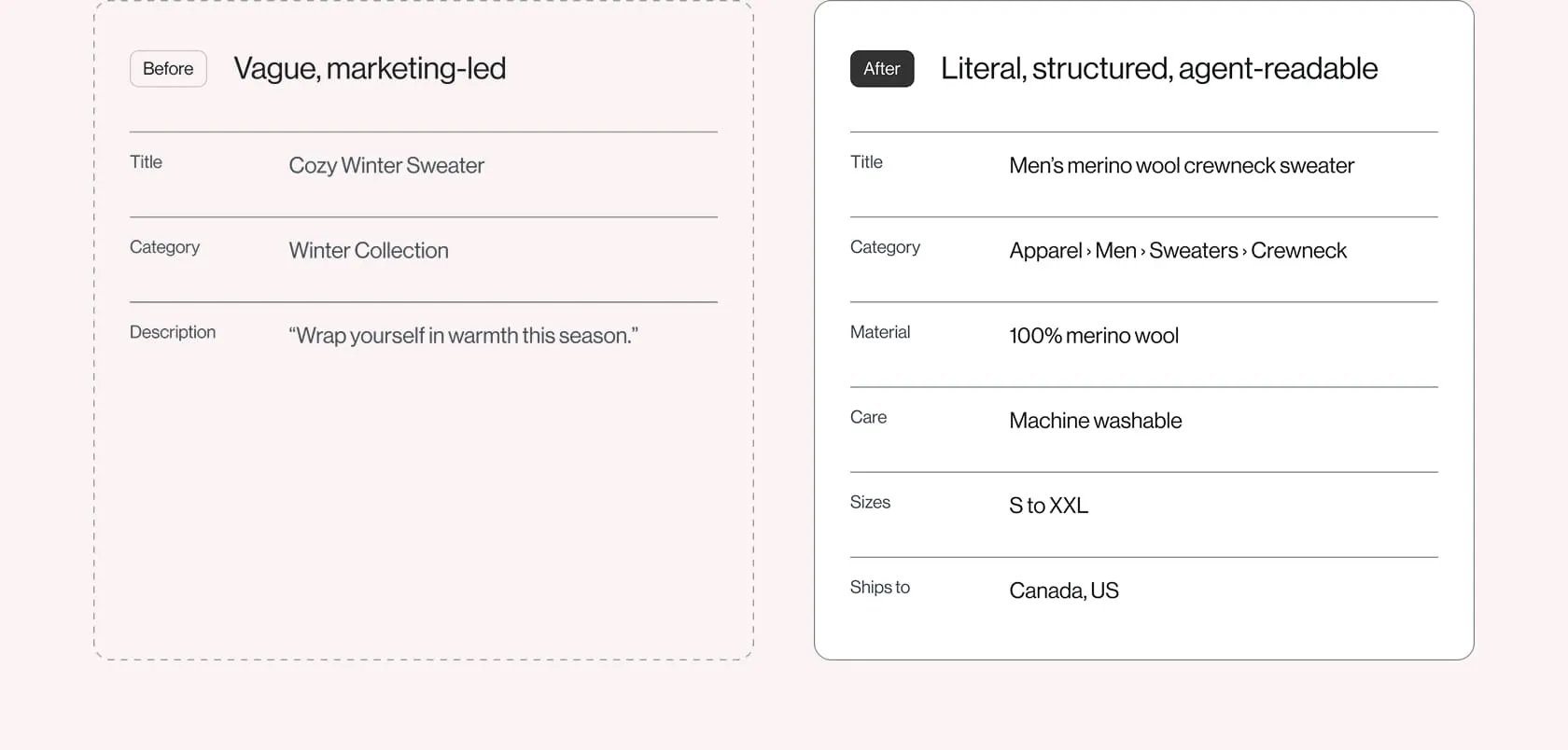
For Shopify merchants specifically, this starts with Shopify Catalog Data for the Universal Commerce Protocol (UCP), an open standard for agentic commerce that Shopify co-developed with Google. Fill out catalog data per product. Use precise taxonomy instead of vague categories. Write literal, descriptive fields instead of marketing copy.

Here’s the difference in practice.

The difference for Shopify catalog data UCP

Now ask an agent "find me a merino crewneck under $150 that ships to Canada and is machine washable." The first record can't answer a single part of that question. The second answers all four.

Confirm your agentic storefront setup too. Eligible Shopify stores are opted in by default, but store owners can manage which AI channels they appear in ChatGPT, Google AI Mode and Gemini, Microsoft Copilot, and Meta in the Shopify admin. Pair that with the Knowledge Base app, which lets AI agents answer shopper questions from FAQs you control.

LLMs work differently. They answer from what they already know, built from being cited, reviewed, and written about across the open web. Someone asking ChatGPT for "the best pizza oven under $500" gets an answer built from that footprint, whether or not they ever visit your site. That's a content and presence problem, and it needs its own owner.

Read: From SEO to GEO

2. Keep your in-stock products visible to shopping agents

AI agents don't just find your products. They check whether those products are actually in stock before recommending them. An agent querying stale inventory data will recommend a product that's sold out, or skip one that's actually available.

Shopify's guidance on agentic-ready product data lays out four requirements here too: real-time accurate pricing and inventory, product variants grouped correctly under one parent record, specific taxonomy instead of broad categories, and machine-parsable data that doesn't rely on JavaScript rendering to display.

System integration with ERP, Commerce

Your ERP, OMS, and PIM have to agree, and fast

For most complex retailers, this is a systems problem before it's a content problem. Your ERP holds the inventory truth, your OMS reflects order status in near real time, and your PIM is where product attributes and taxonomy actually live. If those three systems sync on a delay, or sync only to your storefront and not to the feeds agents query, the agent is working from outdated information.

Audit that sync frequency before Black Friday. Here's what a 15-minute sync delay looks like on the day. Your doorbuster has 400 units. The email goes out at 8am. The product sells out by 8:06. Until 8:15, every agent that queries your feed is still recommending it, sending shoppers to a page that says "sold out." Meanwhile a competitor with a 2-minute sync is picking up the same shoppers. On a normal Tuesday nobody notices a 15-minute lag. On Black Friday it's nine minutes of recommending something you can't ship.

Datmos, with OneStock, offers a complimentary Customer Experience Inventory (CXI) audit. It's built from your own inventory and fulfillment data, benchmarks you against relevant peers, and returns a prioritized action plan in 5 business days.

670%
YoY growth in AI traffic to U.S. retail sites on Cyber Monday. Source: Adobe, 2026
50%+
of AI-referred sessions start on a product detail page (PDP). Compared to about 20% for organic search. Source: Shopify Q1 2026 commerce data

3. Put an AI assistant on your storefront to convert AI-referred traffic

Shoppers referred by AI arrive differently than shoppers referred by organic search.

That means a shopper who asked ChatGPT a question skips your homepage and category pages entirely. They land mid-decision, on one product, with the context of their original question already gone.

PDP AI Assistant

An on-site AI assistant recovers that context.
Picture it. A shopper asks ChatGPT for a roof rack that fits their car, clicks through, and lands on your PDP. They never saw your fitment guide, your shipping page, or your return policy. The assistant fills that gap on the spot:

Shopper: "Does this fit a 2021 Subaru Outback?" Assistant: "Yes, with the raised-rail adapter kit, which is in stock. Both ship together. Order by December 19 for delivery before the 24th. Returns are free within 60 days."

Three questions that would have taken four page visits, answered in one line, without leaving the product.

Test your assistant against last year’s questions, in October

This matters more during Black Friday, when the stakes are higher and the margin for a slow answer is thinner. Traffic spikes, support queues back up, and the shoppers most likely to abandon are the ones who can't get a quick answer at 11pm on the day. Test your assistant against last year's actual top questions before peak traffic hits, not during it, so you're not troubleshooting live while shoppers wait.

Pull the top 50 support tickets and chat transcripts from last year's BFCM weekend and run them through the assistant in October. If it can't answer "when is the last day to order for Christmas delivery" and "is this in stock at the Laval store," fix that before it's answering 2,000 shoppers at once.

Shopify Growth's Campaign Autopilot is a related but separate lever. It runs AI-managed marketing campaigns across channels like Meta, Microsoft Advertising, Shop Campaigns, and email, shifting budget toward what's converting. Merchants set the guardrails, approval level and monthly budget caps and the system optimizes inside them. Pairing that with an on-site assistant closes the loop from ad to conversion.

4. Turn last year's search logs into this year's playbook

Your site search logs from last year's Black Friday are a record of exactly what shoppers wanted, and whether they found it. 

Pull the raw query logs: every search term, whether it returned results, and whether it converted. This data usually already sits in your site search platform or analytics tool.

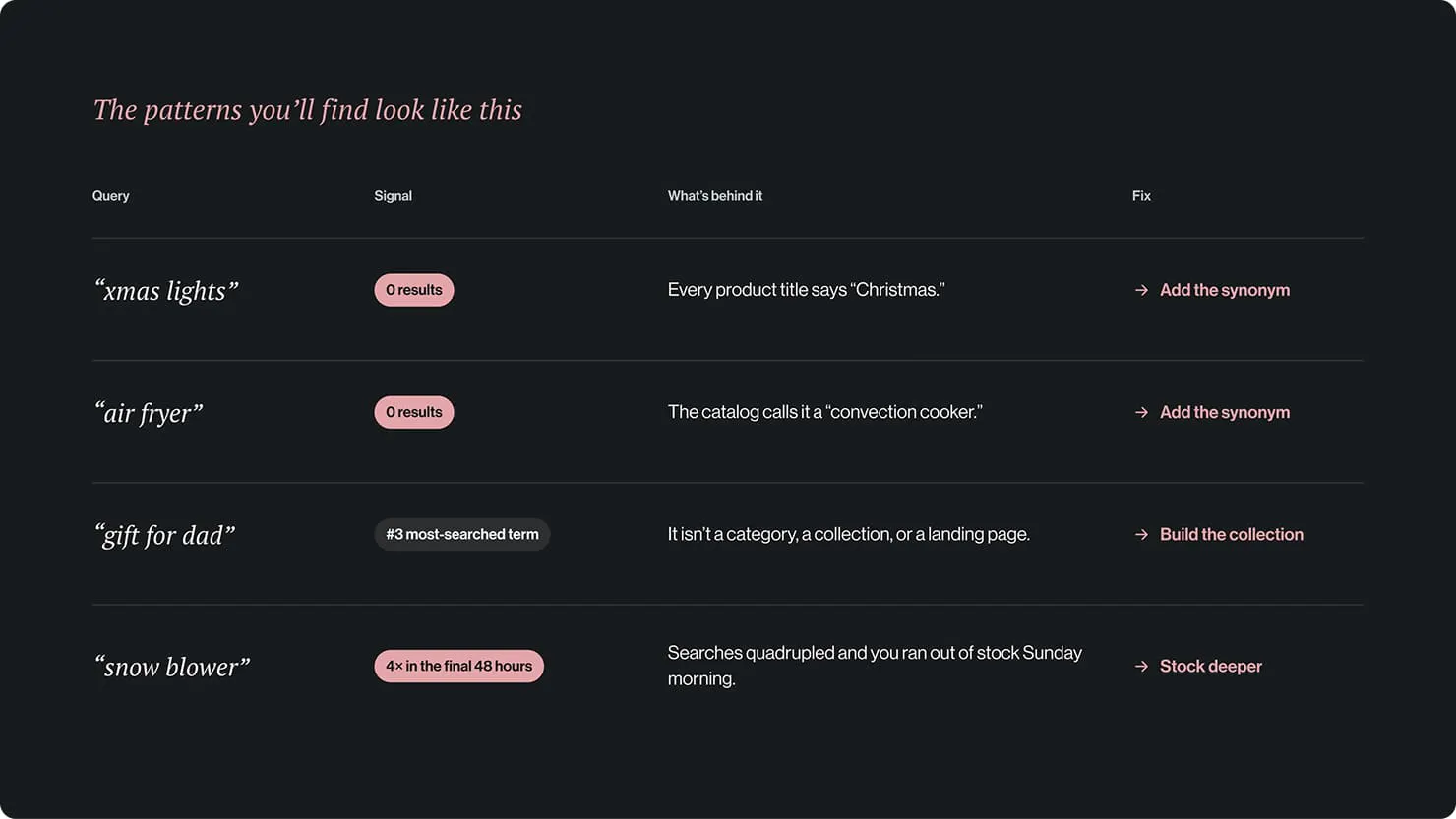
Feed that log to an AI agent and ask it to synthesize the patterns. Which high-volume queries returned zero results? Which searches used language your product titles don't match? Which categories spiked hardest in the final 48 hours?

That synthesis becomes a pre-Black Friday checklist

Search logs

Fix the zero-result searches, add the missing synonyms, and stock up on the categories that spiked last time. The prompt is simpler than it sounds. Export the log as a CSV with three columns (query, result count, conversions) and give the agent this:

"Here are last year's Black Friday weekend site searches. Group the zero-result queries by shopper intent, match each group to the closest existing product or category, and rank the ten fixes that would recover the most sessions. Then list the queries that grew fastest in the final 48 hours."

That output is your checklist: synonyms to add, collections to build, and categories to overstock.

5. Build alerts, monitors, and infrastructure for peak-hour traffic

Black Friday traffic doesn't arrive gradually. It spikes in narrow windows, often triggered by a specific email send, a specific ad, or the exact hour a discount goes live, and no team can watch every dashboard in real time when that happens.

Automated alerts should flag failures before a human notices them: checkout error rate climbing, page load time crossing a threshold, inventory sync falling behind, or a top category returning zero search results. Set these thresholds in October, so your team isn't scrambling to define them on the morning of.

On infrastructure, three fundamentals do most of the work. Auto scaling adds server capacity automatically as traffic climbs, instead of capping out on a fixed number of servers sized for an average day. Load balancing spreads incoming requests across those servers so no single one becomes the bottleneck.

A content delivery network (CDN) caches your static assets, images, scripts, product pages, closer to the shopper, cutting load time during exactly the hours load time matters most.

6. Use predictive AI to anticipate demand and customer needs

Predictive tools like Bloomreach's Loomi analyze historical and behavioral data to forecast demand ahead of the event, rather than reacting once it's already happening. Paired with a customer data platform (CDP) that centralizes customer data across channels, this turns Black Friday planning from a guess based on last year's totals into a forecast based on this year's behavior.

Rate strat for Black friday

What that looks like in practice

Shoppers who bought a pizza oven in October 2025 bought a peel, a cover, and a pizza stone in the Cyber Monday window at three times the base rate. A predictive model surfaces that in September, so you bundle the accessories, stock them at the right depth, and put the bundle in front of every October oven buyer before the sale starts. Last year's totals tell you how many ovens you sold. A model tells you what those buyers will want next.

That same CDP data can anticipate individual needs, not just aggregate demand, surfacing what a specific customer is likely to need next, based on what similar customers needed before. AI tools like Loomi can also power instant, predictive customer support, answering a question before it becomes a support ticket.

During Black Friday specifically, that's the difference between a shopper who gets an immediate answer and one who gives up waiting in a queue. A retailer recording data knows what sold last year. A retailer with a predictive model knows what's likely to sell this year before the first order comes in, and that head start matters when the whole season comes down to a few days.

7. Build a year-round commerce ecosystem, not a holiday campaign

Treating Black Friday as a standalone campaign means starting over every year: new creative, new promo logic, new inventory plan, disconnected from what happened in Q1 through Q3. A commerce ecosystem approach folds Black Friday into the same customer engagement, inventory, and channel logic that runs the rest of the year.

Unify channels, not just expand them

In practice, that means unifying channels, not just expanding them. A shopper who checks inventory on your app, buys online, and returns in-store expects consistency at every step, not 3 disconnected systems that happen to share a logo. Shopify can unify online and physical retail channels under one system. For a more composable approach, commercetools lets you assemble a custom architecture from best-of-breed tools instead of one vendor's full stack. A PIM like Akeneo, combined with generative AI, can automate product categorization so product information stays consistent everywhere it appears, a direct requirement for the agent discoverability covered in section one.

The takeaway

Black Friday and Cyber Monday prep now splits into two tracks that are easy to treat as one: making your systems machine-readable for agents, and making your brand present enough for LLMs to cite you without a visit. Neither is optional anymore, and it's a lot to take on at once. Datmos treats both as prerequisites, not enhancements, because turning insight into action has to start before the first click of the season.

Datmos works with complex retailers across North America and the types of high-consideration catalogs that Black Friday puts under the most pressure. Datmos combines strategy, design, technology, and AI-driven activation to close both gaps simultaneously.

If your team is still determining where you stand on agent readiness or AI visibility, don’t worry, most retailers are in the same position. Talk to Datmos before the season starts, and we’ll help you find the clearest path forward.

If you don't know where you stand on either, start with the data. The CXI audit takes 5 business days and shows you exactly where your inventory and fulfillment gaps are before the season does.

Get your CXI Audit