Figma to Bloomreach Fastrack - AI Agent: Learn more

Back to Insights

Conference | Datmos x Bloomreach: Stop Leaving Money in Your Database with AI-Powered Personalization

September 10, 2026
Conference with Datmos and Bloomreach

Your database already knows who your best customers are, what they love, and how they want to be reached. Most retailers just aren't using that knowledge. That was the starting point for our session at The Edge Summit, Bloomreach's annual commerce conference for retail and e-commerce leaders, held September 9-10, 2026 in Los Angeles.

Datmos took the stage alongside Bloomreach to share how we've used Bloomreach Engagement, to turn scattered customer data into real acquisition and re-engagement results as part of our AI-driven activation services. Mazin Almusharaf, VP of Digital Strategy & Client Solutions, and Laurene Schenin-King, CRM & Loyalty Consultant, presented two client stories that show what this looks like in practice: Rally House and American Meadows.
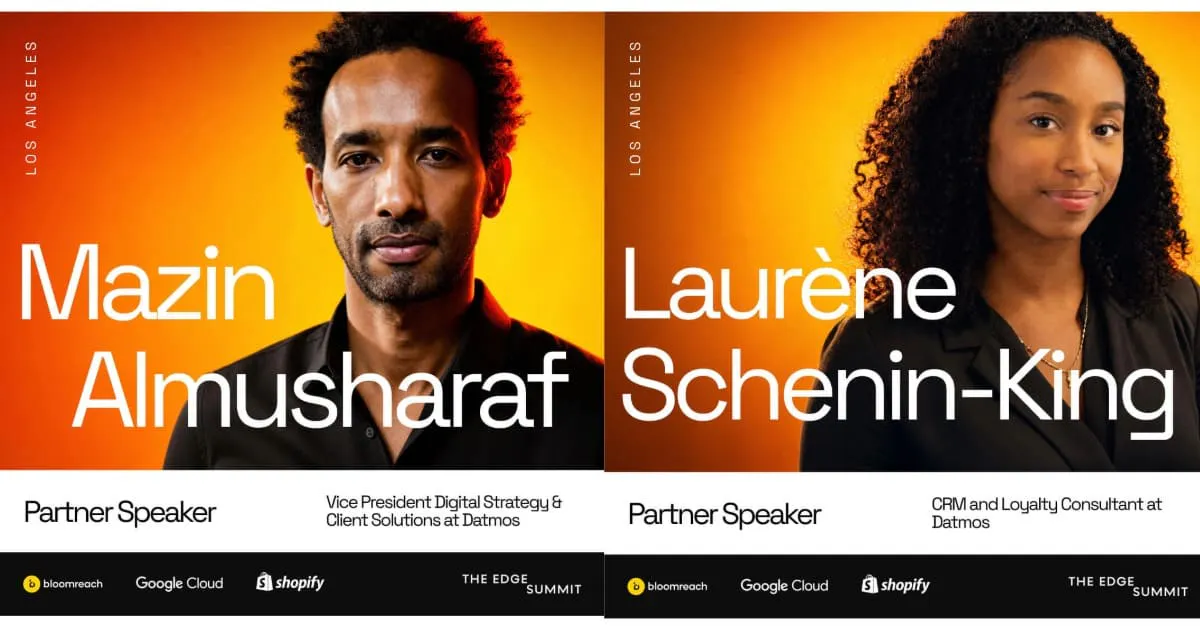

Datmos Speaker at Edge Summit 2026

The problem: every channel had its own version of the customer

Most personalization platforms treat each channel as its own silo. Email has one picture of the customer, the website has another, ads have a third. The result is a fragmented, inconsistent experience, and a lot of manual work for marketing teams trying to stitch it back together.

Bloomreach tool is built differently. Every signal, whether it's a purchase, a browse event, or a declared preference, feeds one profile. That profile is then available in real time to every channel: email, SMS, web, app, media, search, and content. We call this compound value: a platform where every new signal makes every other channel smarter, automatically.

Rally House: turning in-store energy into an online experience

Rally House logo

Rally House is a specialty sports retailer and a category leader in team merchandise. Their in-store experience is genuinely well done: stores are tailored to the local fan base, mascots greet shoppers, and the assortment reflects the teams people actually care about.

The challenge was carrying that same personal, local feel online. Before working with Datmos, Rally House's previous marketing automation setup had three structural problems:

  1. Personalization ran on fixed rules. If a customer liked team X, they'd get shown team X. There was no system that learned and adapted over time.
  2. Outreach ran on a fixed sequence. Campaigns were built for broad segments, not tailored to individual behavior or team affinity.
  3. Nothing learned from last time. Every send was treated as a one-off, with no refinement based on whether the previous outreach actually worked for that customer.

As Mazin put it on stage, everything was a silo.

Building one profile that powers every moment

To fix this, Datmos unified Rally House's data sources into a single customer profile: in-store POS data feeding the same profile as the website, declared preferences from a preference center, purchase history (including preferred team, league, and store), and website activity like browsing and cart adds.

Laurene walked through how this profile gets built and used. The team created a data flow scenario that captures purchase events, such as an in-store purchase tied to a specific team, and writes them as attributes on the customer profile. From there, those attributes feed three things at once: segmentation, product recommendations, and web layers, all matched against catalog attributes like team name.

Loomi also predicts the right channel per customer, not just the right message. For customers whose engagement history shows email alone underperforms, Loomi shifts to SMS. On the segment where SMS was the predicted preferred channel, conversion rate reached 16%, a 7-point lift compared to a non-predictive channel split.

As Laurene noted, the preference center makes this look simple, but there's real logic, build work, and collaboration with the client behind it. Carrying that same energy online, at scale, across hundreds of collegiate properties, was not the easiest problem to solve. It is, however, a genuinely powerful one once it's built.

American Meadows: solving for climate, not just catalog

American Meadows Logo

Our second example, American Meadows, is a gardening and seed retailer with a different kind of personalization challenge: geography. What grows well in one climate zone fails in another, and a generic product recommendation doesn't serve any customer well.

American Meadows came to Datmos with a specific requirement: personalize recommendations consistently across website and email. The solution was to infer each customer's growing zone from purchase and browsing behavior, then activate that zone signal across every channel using the same underlying logic.

This showed up in 3 places:

  1. Product recommendations on site and in email, matched to the zone each customer actually gardens in.
  2. Post-purchase content, where usage guidance is now versioned by zone instead of generic, making it actually relevant to the customer who just bought.
  3. A/B testing across product pages and cart, used to build and activate audiences in marketing.

The bigger point: one profile, compounding everywhere

What connects both stories is that Datmos and Bloomreach aren't running separate systems for marketing and search. It's the same profile, the same signals, feeding every use case, which is exactly what compound value means in practice: the value isn't in any one integration, it's in how each new signal makes every other part of the system smarter at the same time. For the customer, that means one continuous experience instead of a series of disconnected systems that happen to share a logo.

That was the core message we left The Edge Summit audience with: the money isn't in acquiring more data. It's in connecting the data you already have so that every channel gets smarter every time a customer interacts with you.

Datmos partners with retailers to turn customer data into acquisition, retention, and revenue outcomes using Bloomreach and connected commerce platforms.

Read our work