Get your complimentary CXI Audit: Apply today

Back to Insights

Shopify DotDev 2026: Get Ready for Agentic Commerce

July 24, 2026
Conference DotDev 2026

Agentic commerce is moving from hype to measurable results, and Shopify's own ecosystem event just proved it. Shopify DotDev 2026, the platform's flagship conference for developers and partners, took place July 21-22 in Toronto. As a Shopify Platinum Partner, Datmos was on the ground for it, hearing the platform updates and roadmap decisions before they reach the wider market.

The message was consistent across sessions: customer experience is becoming the layer where AI agents, first-party data, the commerce platform, and distribution reach all meet, and brands that connect those threads first will pull ahead.
What is Shopify DotDev?

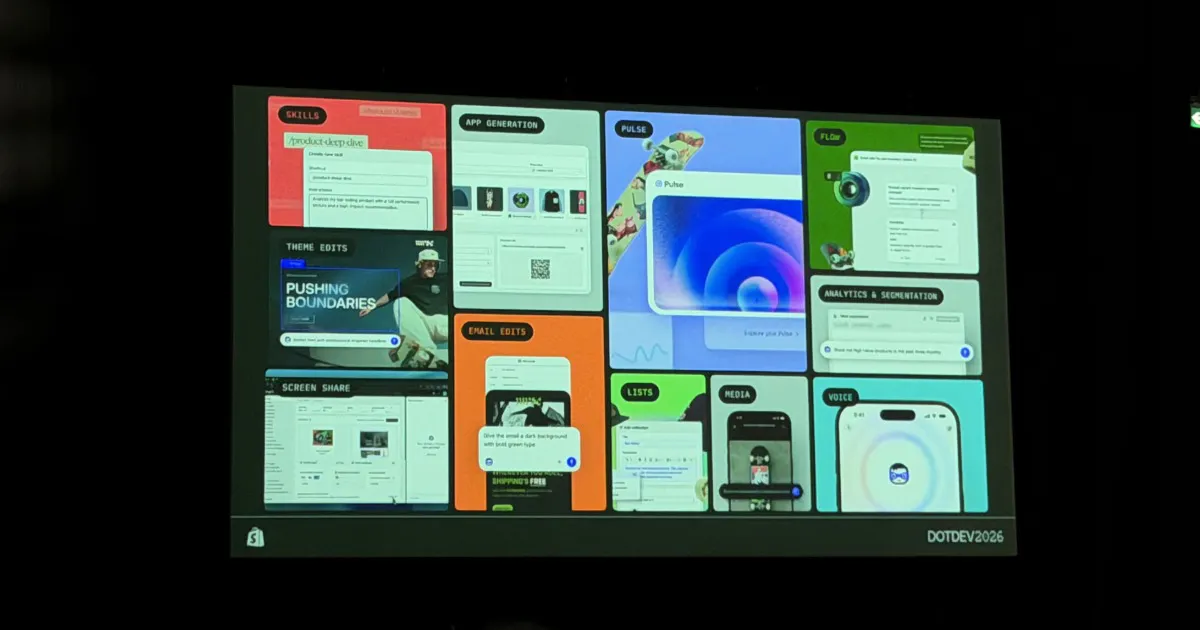
Shopify DotDev is Shopify's two-day global conference for its developer and partner ecosystem, hosted at the Automotive Building in Toronto. The event was formerly known as Editions.dev before its 2025 rebrand. This year's edition went further than product announcements, focusing on how the latest platform updates apply to real client projects.

This isn't our first recap of the event. Last year, when it was still called Editions.dev, we broke down the three updates that mattered most for industrial B2B: AI moving into every layer of the platform, Shopify's growing recognition as a B2B leader, and a rebuilt customer account experience. This year's event pushes that trajectory further, from platform features toward how brands actually put them to work.

Is agentic commerce actually taking off?

Adoption has been slower than the early hype suggested, but the trajectory is strong. Momentum is building toward an inflection point expected within the next two to three years. Brands already using AI and agentic features, even without full agentic commerce, are seeing measurably higher conversion and more cross-site product page traffic.

The early numbers back this up. 

80%
better conversion than organic search. That's what agentic commerce is already delivering, and 50% of AI-driven shopping sessions land directly on a product detail page.

That second stat matters: it means your brand site is still central to the agentic shopping journey, not sidelined by it.

Sales and checkouts through agentic channels have doubled in six months, and Shopify Checkout is powering that growth. This applies whether or not you're on Shopify today. The channel itself is where new customers are showing up, and reaching them is now a distribution question, not just a platform question.

Dotdev 2026

Why are product pages winning first?

Text-based product data, descriptions, and attributes are the easiest content for AI models to parse and surface. That's why product recommendations and PDP visibility are the fastest-compounding wins right now. It's the low-hanging fruit for how these models work today.

Agentic commerce also performs best where products have clearly comparable attributes. Categories like electronics, where consumers are mostly in discovery mode comparing specs side by side, are seeing the strongest early results. This isn't universal yet across every category.

The Next Frontier: Fuzzy Attributes

The harder, higher-value challenge is capturing "fuzzy" signals: merchandising intent, stylist logic, and fitment relationships in both retail and B2B that aren't formal kits or bundles but should be cross-sold together. Formal product data is easy for AI to read. Merchandising judgment is not.

This is a solvable but unsolved layer, and it's where Datmos is already building solutions with clients. It's a real differentiation opportunity for brands willing to invest in it now, not a future nice-to-have.

How is the value in commerce development shifting?

What used to be hard, basic product data structuring, is now easy for AI to handle. What used to be valuable, writing a line of code, now holds less value on its own. The work is moving up the stack.

The opportunity is shifting toward domain expertise: merchandising judgment, commerce experience, and industry knowledge. This favors firms that combine technical fluency with real commerce experience, because that combination is what AI can't yet replicate. It's exactly this pairing, technical depth and commerce judgment, that Datmos has built its practice around.

Agents are also helping teams move faster to the runtime work, where design and UX decisions actually happen. As one Shopify DotDev 2026 session put it, "the runtime is where all of the fun happens." That's also where UX design expertise, the 'taste' layer, becomes essential.

What are the three pillars shaping what's next?

Three areas came up repeatedly across DotDev sessions as the foundation for what's coming:

  1. Platform. Shopify is the ecosystem moving fastest to formalize agentic readiness.
  2. Data. First-party data is now IP. The value isn't just collecting it, it's using it to shape customer experience and journey moments, both internally and externally.
  3. Distribution. How well your products, services, and customer data are distributed across systems and marketplaces, using protocols like MCP and UCP, is becoming a core competitive lever.

Is Shopify ready for enterprise merchants?

The platform gaps that enterprise merchants ran into over the past few years when moving to Shopify have been solved natively. Enterprise readiness is no longer a reason to hesitate on the platform.

Storefronts of the future will be intent-driven. No two visitors will see the same experience on your brand website, because agents, first-party data, and distribution reach will shape each journey individually.

Customer experience is becoming the layer that ties all of this together. Brands that connect their platform, their data, and their distribution strategy now will be the ones agentic shopping journeys favor later.

Datmos combines commerce strategy, design, and technology to help brands build for that shift, whether you're on Shopify today or evaluating the move. If you want to know where your product data and merchandising logic stand against the fuzzy-attribute problem, that's a conversation worth having now.

Contact us